
Topic 4 Intermolecular Bonding – Chemistry HL
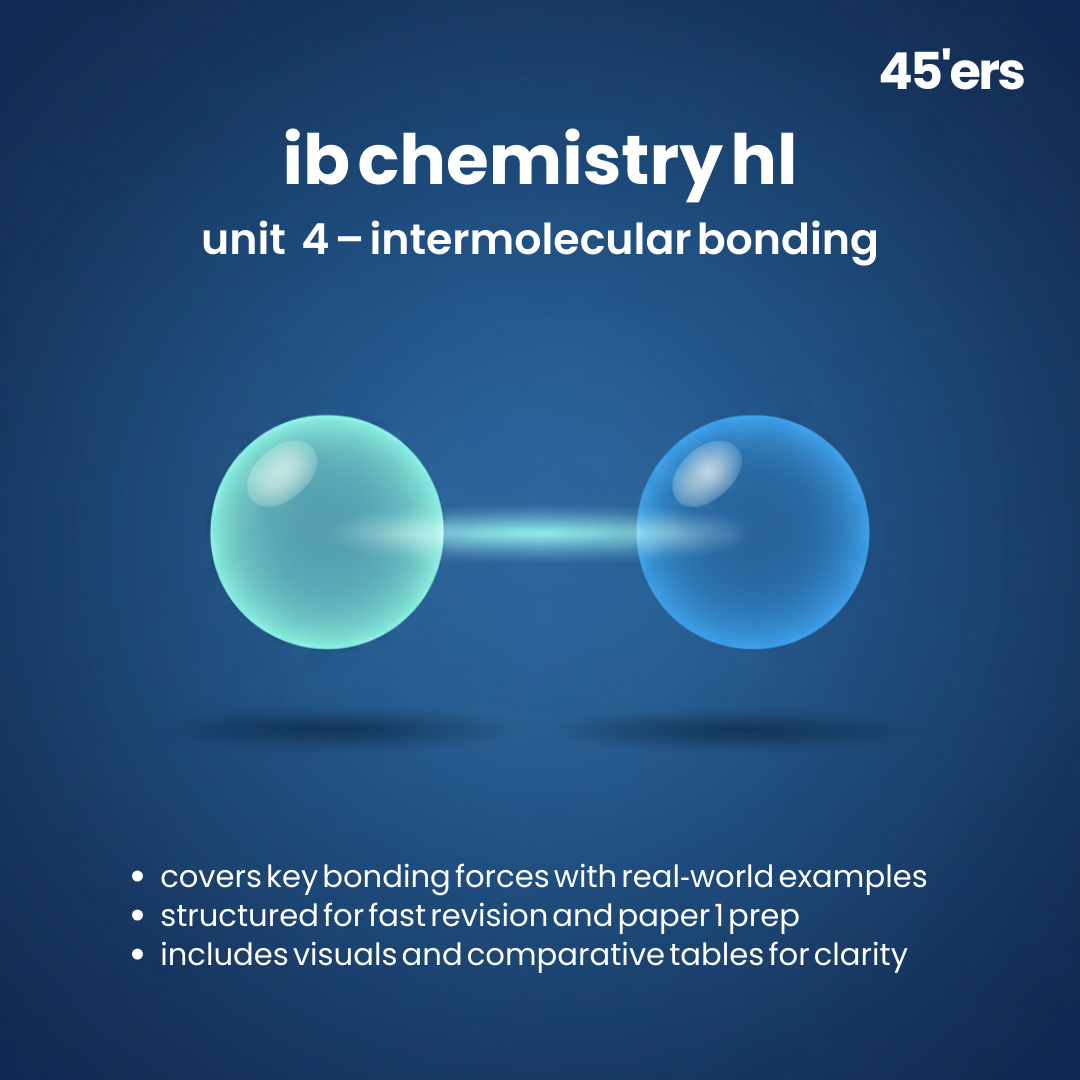
- unit
- handwritten
Topic 4: Intermolecular Bonding
About the Notes: Variation Details:category: Aarshi Majumder ,Experimental sciences,hl, Chemistry HL
Select Author

course content
 Unit 4a Intramolecular Bonding
 - ionic compounds form when oppsitely changed ions attract
- Lonic Compounds have a lattice structure
- The Physical Properties of ionic compounds reflect their ionic structure
- Electrical Conductivity
- Britteness
- Electronegativity
- Bonding Continum
- Octet Rule
- Atoms Can Share More Than One Pair Of Electrons to form Multiple Bonds
- Short Bonds Are Strong Bonds
- Lewis Diagrams are used to show the arrangement of es in covalent molecules
- Co-Ordinate Covalent Bonds
- Valence Shell Electron Pair Repulsion (VSEPR) Theory
- Electron domain
- Repulsion
- Lone Pair (Non-Bonding Domains)
- Molecular Geometry
- Bond Polarity
- Moleculs with Polar bonds Are Not Always polar
- Coordinate Bonds
- Resonance
- PO3-4
- The Formation of covalent bonds often starts with the excitation of the atmos
- Ozone: A Case Study in Resonance
- Oxygen
- O3
- Catailtic Destruction of ozone
- Same Covalent Substances form giant Molecular Crystalline Solids
- Metallic Bonding
- Alloys are Solutions of Metals with Enchanced Properties
 IB Chemistry – SL
Aarshi
Aarshi, known for her aesthetic and insightful notes, was predicted a 44 and became a lifeline for many students in her batch. She's now broadening her horizons with a dual degree at UC Berkeley
 Biology HL
Explore similar Courses
Browse through similar courses to enhance your knowledge and skills
 Sky Patel
Get in touch with us
Let's Work Together to help you achieve your dream ib score